
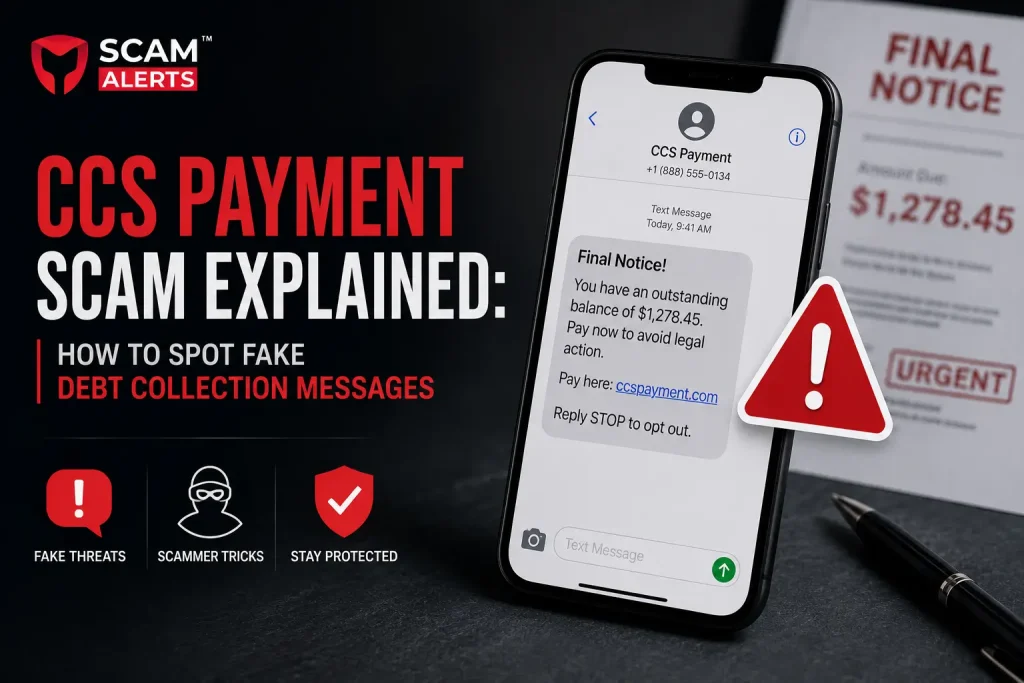
If you have received a text or email claiming you owe money to “CCS Payment,” you are not alone. Thousands of people report similar messages every month and many of them are scams.
These messages usually create a sense of urgency. They say you must pay immediately, or you will face legal trouble or damage to your credit score. That pressure is intentional, it is designed to make you act before you think.
This article explains what the CCS Payment scam is, how it works, and how to tell a genuine debt notice from a fake one. By the end, you will know exactly what to look for and what steps to take before making any payment.
Is CCS Payment a Legit Company?
Yes ccspayment.com is a legitimate debt collection agency but to clear up the confusion, CCS, or Credit Collection Services, It has operated for years and works with real creditors to recover outstanding debts.
So why does CCS Payment scam come up so often? Because scammers use the company’s name deliberately. They know it sounds familiar and official, which makes people more likely to trust the message without checking it first.
This is the core of the scam, borrowing credibility from a real company’s name.
How This Scam Works Actually
Most fake CCS Payment messages follow a similar pattern:
- A message claims you have an outstanding debt
- It demands payment within a short deadline
- It includes a link to make the payment
- It asks for personal or financial details, such as your card number or bank information
A typical example might read something like this:
CCS Payment Notice: Your account shows an unpaid balance of $312.00. Failure to pay within 24 hours may result in legal action. Pay now: link
Notice how vague and urgent the message is. Legitimate collection agencies do not operate this way, which brings us to the next section.
Common Warning Signs
Here are the some signals that looks a message is not genuine:
-
- You do not recognize the debt being mentioned
- The message pressures you to respond immediately
- The sender’s number or email address looks unfamiliar or unofficial
- The link does not lead to a verified company website
- The message contains spelling or grammar errors
- You are asked to pay using gift cards, cryptocurrency, or wire transfer
If you notice even one of these signs, it is best to pause and verify before doing anything further.
Your Rights: What Real Debt Collectors Must Do
This is one of the most important things to know, and it is often overlooked.
Under the Fair Debt Collection Practices Act (FDCPA), legitimate debt collectors are required to send you a written validation notice. This notice must clearly state the amount owed, the name of the original creditor, and instructions for disputing the debt if you believe it is incorrect.
Sources:
Consumer Financial Protection Bureau (CFPB): Notice for validation of debts (12 CFR § 1006.34)
CFPB Consumer Guide: What information does a debt collector have to give me about a debt?
Legal Information Institute (Cornell Law): 12 CFR § 1006.34
If a message pressures you to pay but never mentions this validation notice, that is a strong indication of fraud. Scammers rely on urgency because they do not want you to take the time to verify the claim.
How to Verify If a Message Is Legitimate
Rather than relying on the message itself, take these steps:
- Look up CCS’s official contact number independently, do not use the number provided in the message.
- Check your credit report to confirm whether the debt actually exists.
- Contact the original creditor directly to ask about any outstanding balance.
These steps take only a few minutes and can prevent a costly mistake.
What to Do If You Receive CCS Payment Message
If you receive a suspicious message from CCS Payment, take the following precautions:
- Avoid clicking on any links included in the message
- Do not share personal or financial information
- Block the sender’s number or email address
- Report the message as spam or phishing through your email or phone provider
- Monitor your bank and card statements for any unusual activity
What to Do If You Already Replied a Message
If you have already made a payment or shared personal information, act quickly:
- Contact your bank or card provider immediately and explain the situation
- Request that they freeze or reissue your card if necessary
- Update your passwords, particularly if you shared login credentials
- Report the incident to the Federal Trade Commission at reportfraud.ftc.gov and to the FBI’s Internet Crime Complaint Center at IC3.gov
Acting promptly can significantly reduce the potential damage.
How to Protect Yourself In This Situation
A few simple habits can help you avoid scams like this in the future:
- Always verify a debt before making any payment
- Avoid clicking links in unexpected messages, even if they appear official
- Enable account alerts so you are notified of unusual activity
- Before clicking on any suspicious link, check it url on Scam Alerts to see if it has been flagged as unsafe
Frequently Asked Questions
Q1. Is CCS Payment legitimate?
CCS is a real company, but scammers frequently impersonate it. Always verify a message before taking action.
Q2. How can I confirm whether a debt message is genuine?
Look up the company’s official contact information independently, check your credit report, and request a written validation notice.
Q3. What should I do if I already clicked the link?
Avoid entering any information if you have not already done so. If you have, update your passwords and monitor your accounts closely.
Q4. Can this scam lead to identity theft?
Yes, particularly if you shared sensitive information such as your Social Security number or banking details. Monitor your accounts and credit report regularly.
Q5. Where can I report this scam?
You can report it to the FTC at reportfraud.ftc.gov or to the IC3 at IC3.gov.
Conclusion
The CCS Payment scam depends on one thing, urgency that prevents people from thinking clearly. Now that you understand how it works, what your rights are, and how to verify a message, you are better equipped to protect yourself.
The next time you receive a message like this, take a moment to pause and verify the facts. And if you are ever unsure about a link or website, use Scam Alerts to check it before taking any action.