
1. Scale & Global Prevalence
| 70%
Adults exposed to a scam in the last 12 months |
57%
Adults who actually fell victim to a scam |
| 46,000
Adults surveyed globally |
42
Markets covered |
One in eight adults globally encounters a scam every single day, a staggering indication of how normalized scam activity has become.
Daily Exposure Rate
- 13% of adults globally encounter a scam at least once a day
- Highest daily exposure: USA (29%), Argentina (24%), Brazil (22%)
Regions with Highest Scam Exposure
- Oceania: 73–82% (highest globally)
- South America & Africa: 72–81%
- North America: 66%
- Europe: 66% (lowest exposure)
Top Individual Markets by Scam Exposure
- Kenya — 83%
- Ireland — 79%
- Australia — 74%
- Argentina — 74%
- United States — 70%
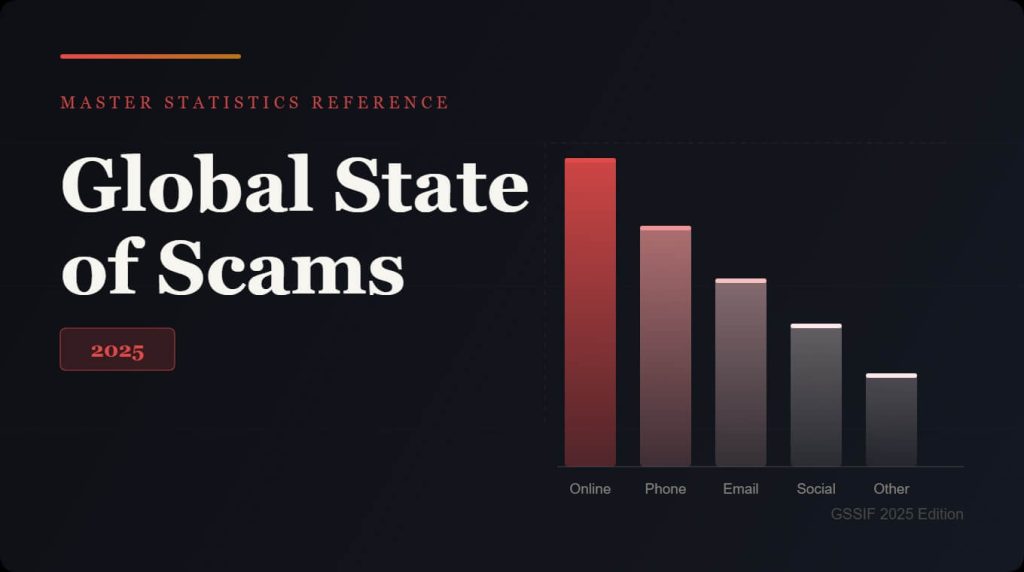
Most Common Channels Used by Scammers
- Phone calls — 53%
- SMS/text messages — 51%
- Email — 47%
Most Misused Platforms
- WhatsApp — 53%
- Facebook — 41%
- Gmail — 38%
2. Financial Losses
| $442 Billion
Estimated Global Scam Losses in 2025 Lost worldwide in the last 12 months |
| 23%
Adults globally had money stolen |
41%
In South America & Africa, nearly double |
Average Loss Per Victim, Top 5 Countries
| # | Scam Type | % of Victims |
| 1 | Austria | $2,885 |
| 2 | Saudi Arabia | $2,511 |
| 3 | Australia | $2,384 |
| 4 | Belgium | $2,218 |
| 5 | Singapore | $2,132 |
Average Loss Per Victim, Lowest (Context for Developing Nations)
- Romania — $113 average loss
- Indonesia — $115 average loss
- Türkiye — $116 average loss
GDP Impact (Disproportionate Burden on Developing Nations)
- Nigeria: scam losses = 11.3% of GDP (highest globally)
- Kenya: 10.9% of GDP lost to scams
- Compare: Sweden (0.02%), United States (0.2%)
This means scams hit developing economies exponentially harder relative to national wealth — a critical angle for coverage.
3. Most Common Scam Types
Among adults who reported being scammed, these were the most frequently encountered types:
| # | Scam Type | % of Victims |
| 1 | Shopping Scams | 54% |
| 2 | Investment Scams | 48% |
| 3 | Unexpected Money / Advance Fee Scams | 48% |
| 4 | Identity Theft | 42% |
| 5 | Impersonation Scams | 41% |
| 6 | Charity Scams | 40% |
| 7 | Fake Invoice Scams | 40% |
| 8 | Employment / Job Scams | 39% |
| 9 | Romance / Relationship Scams | 34% |
| 10 | Blackmail / Extortion Scams | 31% |
4. How Fast Scams Happen
| 64%
of scams completed within ONE day |
47%
happen within minutes of first contact |
The speed of scams is one of the most alarming findings; nearly half are fully executed before a victim has time to think twice.
Breakdown of Speed
- Within minutes: 47%
- Within hours: 17%
- Within one day total: 64%
Regional Speed Comparison
- South America — Fastest: 76% completed within a day
- Asia — Slowest: 60% completed within a day
- Scams on smaller platforms (QQ, WeChat, Roblox, Reddit): only 63–71% spotted within a day
- Scams on Gmail/Facebook: 88–89% recognized within a day
5. How Scammers Receive Money
Understanding payment methods helps readers protect themselves at the point of transfer:
| # | Scam Type | % of Victims |
| 1 | Wire / Bank Transfer | 29% |
| 2 | Credit Card | 18% |
| 3 | Debit Card | 17% |
| 4 | Digital Wallet / E-Wallet | 17% |
| 5 | PayPal | 14% |
| 6 | Peer-to-Peer Payment (e.g. Venmo, Zelle) | 14% |
| 7 | Cryptocurrency | 11% |
| 8 | Gift Cards | 7% |
Regional Payment Highlights
- Bank transfers are highest in Asia (35%) and South America (34%)
- Gift cards are the classic untraceable method — still used in 7% of cases
- Crypto is used in 11% of scams globally — popular in tech-savvy demographics
6. Reporting & Money Recovery
| 74–75%
Victims reported scam to payment provider |
30%
Successfully recovered at least some money |
| 20%
Never reported to anyone at all |
1 in 10
Victims reported to police |
Top Barriers to Reporting
- Did not know who to report to — 36% (Report 1) / 24% (Report 2)
- Felt it wasn’t important since no money was lost — 35%
- Perceived it wouldn’t make a difference — 23%
- Shame — especially high in Africa (13%) and South America (10%)
- Argentina: Two-thirds of victims don’t report at all
Recovery Rates by Region
- Best recovery: Oceania — 55% of reporters recovered funds
- Middle East — 49% recovery rate (also the highest reporting rate at 85%)
- Worst recovery: South America — 32%
Platform Response to Reports
- 70% of those who encountered a scam reported it to the platform
- 34% said the platform took NO action after they reported
7. Emotional & Psychological Impact
| 69%
Felt stressed by being scammed |
58%
Experienced at least one emotional impact |
| 45%
Reported moderate-to-significant mental well-being impact |
36%
Became MORE vigilant after being scammed |
Emotional Impact Breakdown
- 69% — felt stressed (South America highest at 85%, Africa 83%)
- 25% — now distrust digital tools
- 17% — experienced a drop in confidence
- 14% — reported heightened family tension and stress
- 14% — reduced their normal spending behavior.
Children at Risk
- 22% of parents with children aged 7–17 say their child has been scammed
Victim Blaming (% who blamed themselves)
- Argentina — 25%
- Brazil — 20%
- India — 19%
- Kenya — 18%
Lower-GDP countries suffer disproportionately across emotional, financial, and relationship impacts.
8. Who Is Most Vulnerable?
Compared to the 23% global average for money loss, these groups face elevated risk:
Demographics More Likely to Lose Money
- Gen Z — 27% lost money (higher than average, despite digital savviness)
- Millennials — 26% lost money
- Parents — 27%
- Higher educated individuals — 26% (counterintuitively higher risk)
- Low-GDP country residents — 30%
- South America / Africa residents — 41%
The Confidence Gap, Key Blog Angle
| 73%
Feel confident they can spot a scam |
23%
Still lose money anyway |
- Younger adults who feel most confident are ALSO most likely to fall victim
- 93% of adults claim to take at least one step to verify an offer — yet scams still succeed
- Main reason victims were scammed: the scam felt very realistic (21%) — especially for Gen X and Boomers
Ineffective Prevention Methods People Rely On
- Checking for spelling/grammar errors — 27% (less reliable with AI)
- Looking for reviews on the same website — 24% (can be faked)
- Checking if the company is on social media — 21% (easily fabricated)
- “If it seems too good to be true” rule — 31% (most popular but insufficient)
9. Responsibility & Accountability
Who do adults believe should protect them from scams?
Who People Blame / Expect to Protect Them
- Public service or commercial organisations — 35%
- Online platforms — 35% (cited most responsible, but ranked lowest in performance)
- Government — 13–23%
- Personal responsibility — 23%
Who Performs Best (Public Perception)
- Banks, insurance companies, and police are seen as performing best
- Governments and online platforms rank highest for responsibility — but lowest for performance
Reimbursement Expectations
- 45% of adults believe banks should ALWAYS reimburse scam victims
- 32% globally favour full reimbursement as the maximum punishment for scammers
10. AI & Emerging Scam Threats
Expert commentary from Europol and Feedzai analysts highlights a rapidly evolving threat landscape:
AI-Powered Scam Operations
- Criminals are now trading AI models alongside stolen data and hacking tools
- AI enables deepfakes, hyper-personalised phishing, and Business Email Compromise at an industrial scale
- Scam lures now bypass traditional grammar-check detection (undermining that as a safety tip)
Organised Crime Involvement
- Transnational criminal groups — including the Jalisco Cartel and North Korea’s Lazarus Group — run industrial-scale scam operations
- DNS abuse gives scammers cheap infrastructure to host fake platforms and evade detection
The Stakes of Prevention
| $40 Billion
Potential Annual Denial of Criminal Revenue A 25% reduction in global scams would deny criminal organisations this amount each year |